Learning to Live Together.
Why do we give so little attention to the child?

In ageing there are many aspects of life that become clear, sometimes almost fleetingly, and just as many that are blurred by experience. It is like the movement of waves and the turning of tides; nothing stays still and it’s impossible to control.
This Christmas all our family visited us in our small, rented cottage in rural Dorset. All the rooms, apart from the kitchen and bathrooms, are occupied by sleepers during the night. Ages range from 11 months to 74 years and in the dark mornings I and my youngest grandson meet over breakfast. He smiles and stares at me through unblinking eyes as if to penetrate my old, tired brain. We bend towards each other and gently place our foreheads together, closing our eyes in wordless communication across ages, and across all boundaries of time and space there is harmony and wholeness. Such a thing can exist only when innocence emerges and experience disappears.
Almost all my life has been with children and young people. I grew up the second in a family of six boys. My elder brother is 13 months older than me and there are 8 years that divide me from my youngest brother. There are 4 of us left. I have found fascination in the process of growing up; following that transition into potential maturity and wisdom, which is so often lost and very occasionally regained.
Here is one thing, though… the existence of the child is not a stage to be put to one side in the pursuit of knowledge or even understanding. Neither is the process of ageing with the degeneration of the body to be put aside as signalling the ceasing of a reality that no longer holds any significance. The child flows through the adult and the adult returns to the child.
The magic that binds this movement together is learning. That extraordinary aspect of the humankind is the ability to learn within the existence of a consciousness of which we have little understanding, give so little time to its exploration.
At the centre of it all is the child. The child is the beginning, the middle and the end. The seed, the flower and the withered stem.
The child lives in me and you and, despite the modern obsession with categorisation and separation, this is the ebb and flow of generations.
If this is the case, why do we give so little attention to the child?
Why are most children nurtured and cared for a relatively short time and then given over to the Government to bring up according to the dominant ideology or world view for the rest of their lives?
At this time of unprecedented world crisis, I feel it is vital to turn our attention to our relationship with our children and through that relationship come to an understanding that puts learning to live together as the project for humanity.
Is it not an extraordinary thing that you and I are alive? That we are creatures of amazing complexity in both body and mind. We don’t know where we come from and, despite very confident statements from different religions, we really don’t know where we’re going to end up.
You and I are unique, born in a particular space and time. This means there never has been nor ever will be an individual quite like me or you. Somehow, we have been given the gift of life. It is really quite magical and worthy of celebration.
So why is life treated so cheaply?
I became a teacher not to be the power in the classroom, I’ve always had mixed feelings about being in the classroom; nor through the possibility of imparting my superior knowledge to young, impressionable minds. I had always felt that working with young people would give me the opportunity to explore and learn what it is like to be human. It took me nearly ten years of being in schools before I was able to take that path I always knew existed.
Now I have come to the feeling that as I move towards the tipping point of my eighth decade that I must be more active in communicating the urgency of this inquiry. Consequently, I am going to continue to use my personal Substack as an exploration of where I am now and my reflections on my work with children and young people. My intention is that the regular monthly contributions I will make to the Revolution in Mind Substack -
- will involve more practical explorations of how the approach to the organisation of learning might change in order for children and young people to be involved in finding out about themselves and their relationship to the world.
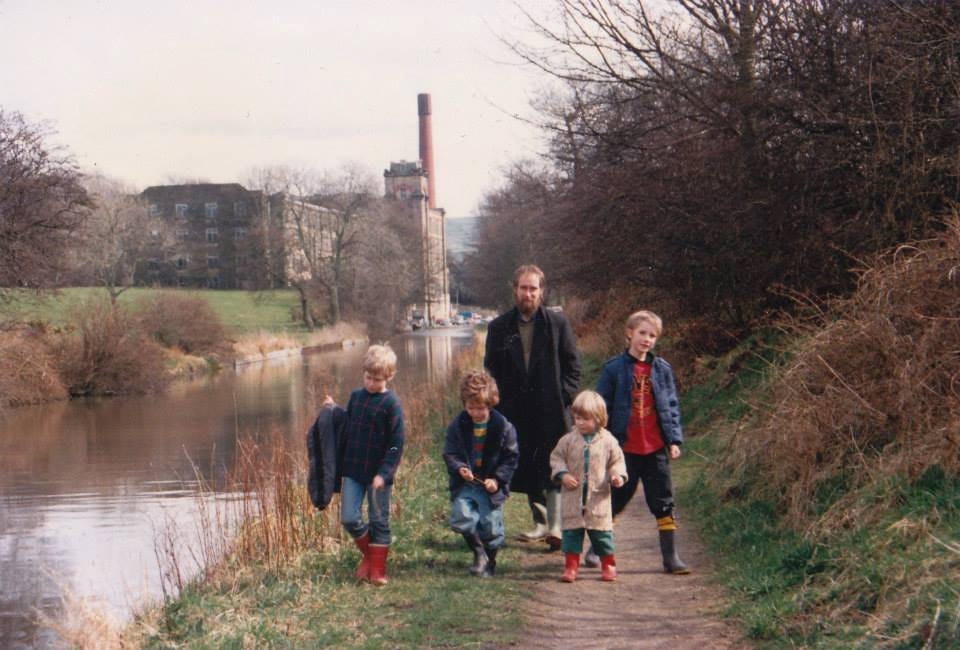
Many thanks, Gavin. Maggie took the photo when we were walking along the banks of the canal with Clarence Mill, Bollington near Macclesfield in the background. I am with our four sons whose ages must then have been around, 11, 9, 6 and 4, which makes it in the late 1980s. Clarence was a cotton mill where Maggie's dad worked 12 hour shifts for many years after returning from the Second World War. It is one of my favourite photos. I look forward to hearing your 'brief' notions soon.
Thank you very much, Elaine. I feel that there is a great deal to be leanred by being in the company of children and young people, and this goes for older people as well. I'll be exploring how changing approaches to learning may contain the seeds of a more peaceful and caring world.